
Mutual Funds vs AIF vs SIF: Which Investment Option Is Right for You?
What Are Mutual Funds?
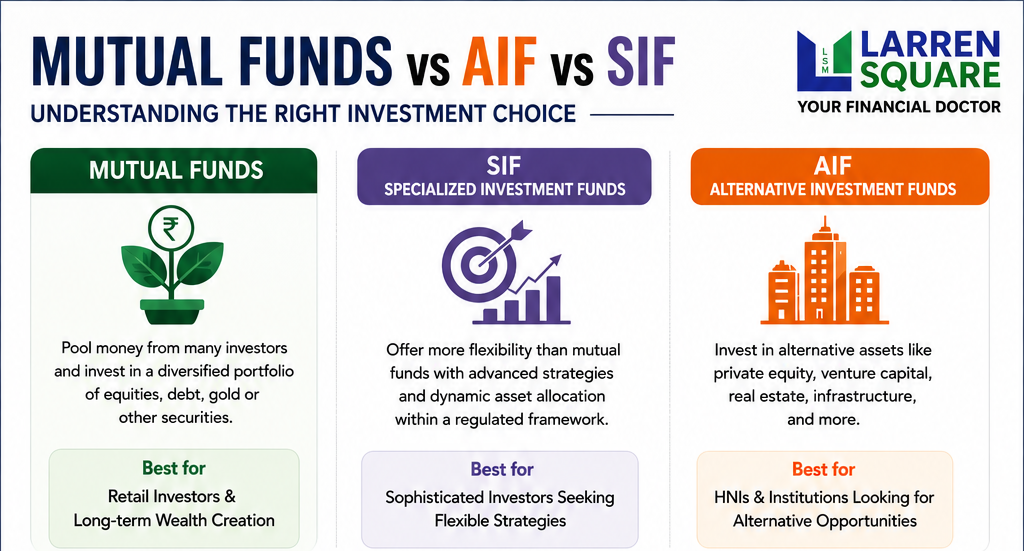
A Mutual Fund pools money from multiple investors and invests it in a diversified portfolio of equity, debt, gold, or hybrid securities. Professional fund managers make investment decisions on behalf of investors.
Mutual Funds are regulated by SEBI and are suitable for beginners as well as experienced investors.
Key Features
Professionally managed
Diversified portfolio
Low investment amount
High liquidity (for open-ended funds)
Available through SIP and Lump Sum investments
Best For
First-time investors
Salaried professionals
Long-term wealth creation
Retirement planning
Goal-based investing
What Is an Alternative Investment Fund (AIF)?
Alternative Investment Funds are privately pooled investment vehicles that invest in assets beyond traditional stocks and bonds.
These may include:
Private Equity
Venture Capital
Startups
Real Estate
Infrastructure
Distressed Assets
Hedge Fund Strategies
AIFs are designed primarily for High Net-Worth Individuals (HNIs), Ultra-HNIs, family offices, and institutional investors.
Key Features
Higher risk
Higher return potential
Limited liquidity
Professional fund management
Minimum investment of ₹1 crore (with certain regulatory exceptions)
Best For
Experienced investors
HNIs
Investors seeking portfolio diversification
Those comfortable with long investment horizons
What Is a Specialized Investment Fund (SIF)?
Specialized Investment Funds (SIFs) are a relatively new investment category introduced to bridge the gap between traditional Mutual Funds and AIFs.
SIFs provide fund managers with greater flexibility in investment strategies compared to regular mutual funds while remaining under a regulated framework.
These funds may employ:
Long-short strategies
Dynamic asset allocation
Advanced portfolio management
Multi-asset investing
Tactical investment approaches
Key Features
More flexible than Mutual Funds
Lower investment threshold than AIFs
Designed for sophisticated investors
Regulated investment structure
Advanced investment strategies
Best For
Investors with moderate to high risk appetite
Experienced mutual fund investors
Investors seeking higher flexibility than traditional mutual funds
Mutual Funds vs AIF vs SIF: Comparison
Feature | Mutual Funds | SIF | AIF |
|---|---|---|---|
Investor Type | Retail Investors | Sophisticated Investors | HNIs & Institutions |
Risk Level | Low to Moderate | Moderate to High | High |
Minimum Investment | Starts from ₹500 SIP | Higher than Mutual Funds (scheme-specific) | Generally ₹1 Crore |
Liquidity | High | Moderate | Low |
Investment Strategy | Traditional | Flexible & Advanced | Alternative Assets |
Regulation | SEBI | SEBI | SEBI |
Suitable For | Wealth Creation | Tactical Investing | Portfolio Diversification |
Transparency | High | High | Moderate to High |
Investment Horizon | Medium to Long Term | Medium to Long Term | Long Term |
Risk Comparison
Mutual Funds
Lowest risk among the three
Suitable for conservative and moderate investors
Diversification reduces overall portfolio risk
SIF
Moderate to high risk
Uses advanced investment strategies
Better suited for informed investors
AIF
Highest risk
Investments in illiquid or alternative assets
Returns can vary significantly
Return Potential
Although higher risk may offer higher return potential, returns are never guaranteed.
Mutual Funds
Expected returns depend on the category:
Equity Funds
Debt Funds
Hybrid Funds
Index Funds
Suitable for long-term wealth creation.
SIF
Potentially higher returns through flexible investment strategies, but performance depends heavily on market conditions and fund management.
AIF
Can generate substantial returns in successful investments, especially in private equity and venture capital, but may also involve higher volatility and longer lock-in periods.
Liquidity Comparison
Investment | Liquidity |
|---|---|
Mutual Funds | High |
SIF | Medium |
AIF | Low |
Mutual Funds generally allow easier redemption, whereas AIFs often have longer lock-in periods. Liquidity for SIFs depends on the specific fund structure.
Taxation
Taxation varies depending on the investment category and prevailing tax laws.
Generally:
Mutual Funds are taxed according to the type of fund and holding period.
SIF taxation depends on their legal and regulatory structure.
AIF taxation varies by category and applicable pass-through provisions.
Investors should consult a qualified tax advisor before investing.
Who Should Invest?
Choose Mutual Funds If You:
Are a beginner
Want to start investing with small amounts
Prefer SIP investing
Need liquidity
Want long-term wealth creation
Choose SIF If You:
Understand market cycles
Want advanced investment strategies
Can tolerate moderate to higher risk
Seek greater portfolio flexibility
Choose AIF If You:
Are an HNI
Want exposure beyond stocks and bonds
Can invest for longer durations
Understand alternative assets and higher risks
Advantages and Disadvantages
Mutual Funds
Pros
Low investment amount
Easy to understand
Diversified portfolio
Highly regulated
SIP facility
Cons
Limited strategy flexibility
Market risk remains
SIF
Pros
Flexible investment approach
Advanced strategies
Regulated investment structure
Cons
Higher risk than traditional mutual funds
More suitable for experienced investors
AIF
Pros
Access to alternative assets
Potential for higher returns
Portfolio diversification
Cons
High minimum investment
Lower liquidity
Higher risk
Suitable mainly for HNIs
Which Investment Is Best?
There is no one-size-fits-all answer.
Mutual Funds are ideal for most retail investors looking for disciplined, long-term wealth creation.
SIFs suit experienced investors who want more sophisticated strategies while staying within a regulated framework.
AIFs are designed for high-net-worth investors seeking exposure to alternative assets and willing to accept higher risk and lower liquidity.
Your choice should depend on your financial goals, investment horizon, risk tolerance, and available capital.
Final Thoughts
Mutual Funds, SIFs, and AIFs each serve different investor needs. Understanding how they differ can help you build a more suitable investment portfolio.
For most investors, Mutual Funds remain the foundation of long-term investing due to their accessibility, diversification, and ease of investing. As your financial knowledge and investable surplus grow, SIFs and AIFs may become relevant additions to diversify your portfolio.
Whether you're just starting your investment journey or exploring advanced opportunities, choosing investments that align with your goals is the key to long-term financial success.
Recent Posts
-
Stocks vs Bonds: Which Investment Is Right for You?
22 Jul, 2026 -
-

-

-

-

-

-

SIP vs Lumpsum: Which Is Better and When?
17 Jan, 2026 -

-

-

-

Difference Between SIP and Mutual Fund
08 Dec, 2025 -

-

Your Financial Goals Deserve Expert Guidance
Whether you're planning investments, securing retirement, or expanding your business — Larren Square helps you make smarter, well-informed decisions.