
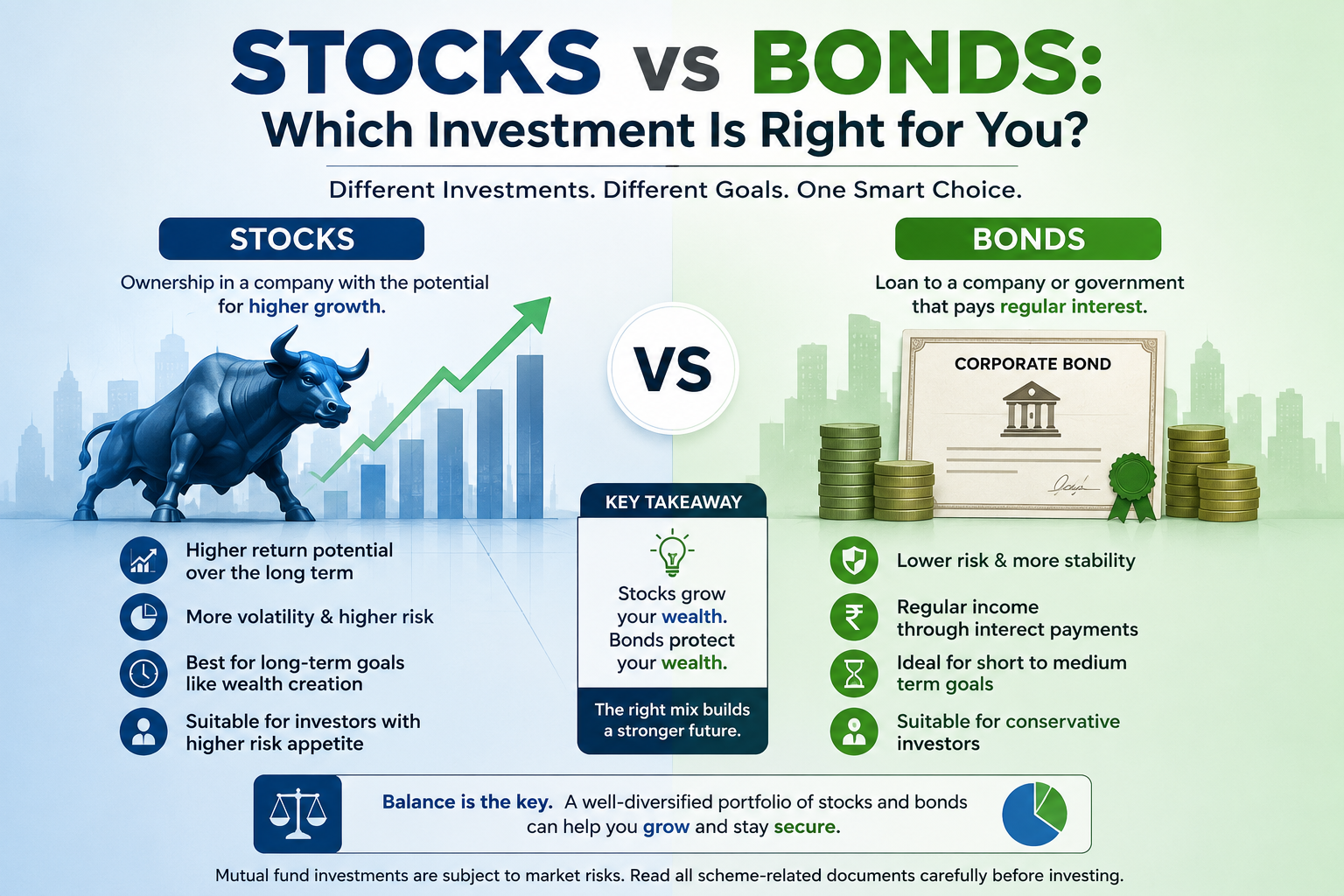
Stocks vs Bonds: Which Investment Is Right for You?
What Are Stocks?
Stocks, also known as equities, represent ownership in a company. When you purchase shares of a company, you become a shareholder and own a small portion of that business.
If the company performs well, the value of your shares may increase, allowing you to earn capital gains. Some companies also distribute a portion of their profits as dividends.
How Stocks Generate Returns
Capital appreciation (increase in share price)
Dividend income
Long-term wealth creation
Advantages of Investing in Stocks
High potential returns over the long term
Ownership in growing companies
Protection against inflation
Dividend income from selected companies
Easy to buy and sell through stock exchanges
Risks of Stocks
High market volatility
Prices can fluctuate daily
No guaranteed returns
Company-specific risks
Market sentiment can affect prices
What Are Bonds?
Bonds are fixed-income investments where you lend money to a government, corporation, or other institution for a specified period.
In return, the issuer pays you regular interest (called coupon payments) and returns your principal amount when the bond matures.
How Bonds Generate Returns
Fixed interest payments
Return of principal at maturity
Advantages of Bonds
Stable and predictable income
Lower risk than stocks
Capital preservation
Suitable for conservative investors
Less volatile during market downturns
Risks of Bonds
Lower long-term returns
Interest rate risk
Inflation may reduce purchasing power
Credit/default risk if the issuer fails to repay
Stocks vs Bonds: Comparison Table
Feature | Stocks | Bonds |
|---|---|---|
Ownership | Partial ownership in a company | Loan to a company or government |
Returns | Capital gains and dividends | Fixed interest income |
Risk | High | Low to Moderate |
Volatility | High | Low |
Income | Variable | Fixed |
Ideal For | Long-term growth | Stable income |
Inflation Protection | Better | Limited |
Investment Horizon | Long-term | Short to Medium-term |
Stocks vs Bonds: Which Offers Better Returns?
Historically, stocks have delivered higher returns than bonds over long investment periods.
However, higher returns come with higher risk. Stock prices can experience significant fluctuations during market corrections or economic downturns.
Bonds generally provide lower returns but offer greater stability and predictable income, making them suitable for risk-averse investors.
Who Should Invest in Stocks?
Stocks may be suitable if you:
Have a long investment horizon
Can tolerate market volatility
Want to build long-term wealth
Are investing for retirement
Seek higher returns
Who Should Invest in Bonds?
Bonds may be a better choice if you:
Prefer stable income
Want lower investment risk
Are close to retirement
Need regular cash flow
Wish to preserve capital
Can You Invest in Both?
Absolutely.
Many financial experts recommend combining stocks and bonds in a diversified portfolio. This strategy helps balance growth and stability.
For example:
Age Group | Suggested Stock Allocation | Suggested Bond Allocation |
|---|---|---|
20–35 years | 80–90% | 10–20% |
35–50 years | 60–75% | 25–40% |
50–65 years | 40–60% | 40–60% |
65+ years | 20–40% | 60–80% |
Note: These are illustrative allocations. The right mix depends on your financial goals, time horizon, and risk tolerance.
Stocks vs Bonds During Market Crashes
During periods of market uncertainty:
Stocks often experience larger price declines.
High-quality government bonds may hold their value better and can sometimes appreciate as investors seek safer assets.
A balanced portfolio containing both asset classes can help reduce overall volatility.
Which Is Better for Beginners?
The answer depends on your goals.
If you're investing for long-term wealth creation, stocks can offer greater growth potential.
If you value capital protection and regular income, bonds may be more appropriate.
Many beginners start with diversified mutual funds or exchange-traded funds (ETFs) that invest in a mix of stocks and bonds, providing professional management and diversification.
Final Thoughts
There is no one-size-fits-all answer to the stocks vs bonds debate. Each asset class plays a different role in an investment portfolio.
Stocks provide growth opportunities but come with greater risk, while bonds offer stability and predictable income with generally lower returns.
A well-diversified portfolio that combines both can help investors pursue long-term financial goals while managing risk. Before investing, assess your financial objectives, investment horizon, and risk tolerance, or consult a qualified financial advisor.
Recent Posts
-
-
-

-

-

-

-

-
SIP vs Lumpsum: Which Is Better and When?
17 Jan, 2026 -

-

-
-

Difference Between SIP and Mutual Fund
08 Dec, 2025 -

-

Your Financial Goals Deserve Expert Guidance
Whether you're planning investments, securing retirement, or expanding your business — Larren Square helps you make smarter, well-informed decisions.